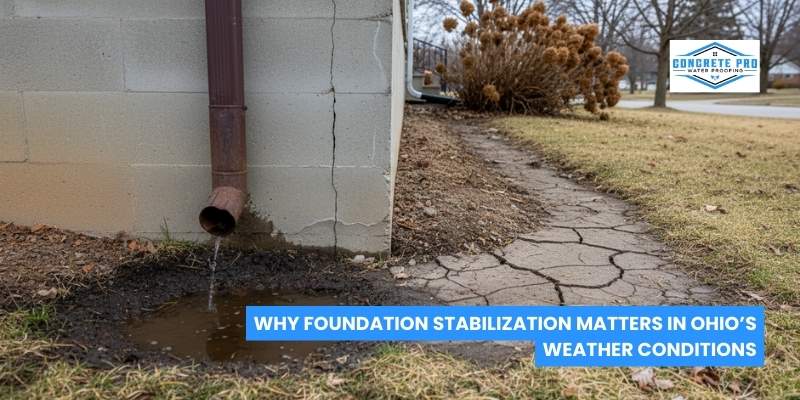
Ohio is a location of weather extremes. The earth around your house is always responding, pressing out, shrinking, filling up and drying up…and at times even moving drastically. This is not an occasional occurrence, and the ramifications affect the very bones of your house: the foundation. Whether you already own a home or want to purchase one, knowing how Ohio’s weather impacts foundation stabilization is imperative.
In this blog we will look into how foundations and the soil surrounding them are affected by Ohio’s climate, what sorts of troubles may occur, and why stabilization and maintenance are so essential.
The Ohio Climate and Soil Context
1. Seasonal Extremes and Soil Movement
Ohio’s climate is “humid continental,” meaning that we experience all four seasons. We have cold winters, hot and humid summers, and rainy springs and falls. These changes in seasons introduce a sequence of moisture changes in the earth near a foundation—occasionally at a rapid and cyclic rate throughout the year.
Clay rich soils, which are prevalent in most parts of Ohio, are particularly reactive. Clay is like a sponge: It swells when water is added to it and shrinks when it loses moisture.
2. Freeze-Thaw Cycles: A Hidden Stressor
When winter arrives, moisture in the ground freezes and swells. Soil expands and contracts every time a freeze-thaw cycle occurs; and in Ohio this may take place dozens of times. This push-pull effect may cause gradual weakening of foundation materials, cracks and variability of gaps, through which water can seep.
3. Moisture Fluctuations: Too Wet or Too Dry
Wetness isn’t the only danger. Moisture deprivation can prove equally disastrous. Prolonged dry or drought-like periods may cause soil to shrink significantly, retracting from foundation walls or slabs and leaving space underneath the building. That lack of even support may cause settlement, cracking or movement.
Dry soil may later be engulfed by heavy rainfall, making it expand again, further increasing the expansion and contraction cycles around the foundation.
How Weather Related Soil Movement Affects Foundations
Mechanics can assist in understanding why stabilization is not only about fixing cracks, but also about controlling forces that are invisible.
Hydrostatic Pressure and Soil Expansion
When the ground gets wet—not only during spring rains, but also when snow melts quickly—soil spreads away in every direction under the footing. The outcome is heightened hydrostatic pressure, which can lead to walls being pushed inward or the formation of cracks.
Even foundations that seem strong may give way to these forces over time, if water is not redirected or soil conditions are not taken care of.
Settlement and Uneven Support
Ohio alternates between dry and rainy seasons. Uneven water supply results in some areas of the soil drying out at a quicker or slower rate than others. Foundations are built on ground that is always in motion.
That unbalanced support may lead to settling or tilting, which presents as cracking, sloping floors, or sticking doors and windows.
Cumulative Damage from Freeze-Thaw Cycles
Repetition matters. One or two freeze-thaw cycles may not destroy a foundation; but tens or hundreds of cycles over decades will result in a gradual loosening and cracking.
The existence of small cracks now translates to bigger structural problems later on, unless conditions are reversed.
Why Foundation Stabilization Is Critical
- Protecting Structural Integrity: Stabilization is not a cosmetic fix; it is all about structural resilience. A shifting, tilting or cracking foundation may weaken walls, floors and even roofing, in the long run. Movement prevention can preserve the integrity of the entire home, not only that of the basement or crawl space.
- Preventing Water Intrusion and Moisture Problems: A weak structure welcomes water intrusion. As soon as moisture gets inside, it turns into more headaches: the presence of mold, mildew, the decay of building materials and poor indoor air quality (IAQ). These problems are expensive and may impact health and resale value.
- Protecting Property Value: Underlying issues are expensive to repair and may hugely lower home value. Buyers are leery of issues that appear to be foundation problems, such as cracks, visible water marks or uneven flooring. Preparation and proactive repairs demonstrate to potential buyers and home inspectors that a house has not been neglected.
- Saving Money in the Long Run: Proactive methods of stabilization, such as adequate drainage, soil moisture regulation and structural strengthening, are usually cheaper than post-damage stabilization. Once movement causes significant cracking or bowing in a wall, repair prices may reach tens of thousands of dollars (or higher).
Key Strategies for Ohio Homeowners
You do not need to be an engineer to secure your foundation, but you have to know the fundamentals:
- Drainage is necessary. Gutters, downspouts and grading must direct water away from your foundation, not toward it.
- Control soil moisture levels. Both too much and too little water are destructive. During droughts or rainy seasons, implement irrigation or moisture management techniques.
- Conduct periodic checks. Pay attention to cracks, sticking doors, uneven floors, etc. These are all signs that should be looked into by a professional.
- Utilize professional stabilization, where necessary. Certain cases may require foundation repair, reinforcement or waterproof protection carried out by professional experts.
Conclusion
The weather in Ohio is not kind to foundations. From downpours and droughts to freeze-thaw cycles, your home’s foundation is at the epicenter of the constant changes wrought by nature.
Stabilization is important for the safety, security and overall value of your home. Foundation stabilization is not a luxury; it is a safety net against the very elements that control the seasons of the year.
If you are concerned about your foundation or would like to learn more about stabilization, contact Concrete PRO.