A well built patio feels permanent. Solid. It is going to hold summer dinners, quiet mornings and years of foot traffic without complaint. And most of the time, it can…if water is handled properly. Drainage is the part of patio construction that rarely gets attention, yet it is the single most common reason that patios fail. Not color choices. Not stone type. Water.
When drainage is ignored or poorly designed, even the best pavers, concrete or natural stone will eventually crack, shift, sink or stain. Slowly at first. Then all at once. Let’s walk through the drainage mistakes that quietly ruin patios and what actually works instead.
Why Drainage Makes or Breaks a Patio
Water always wins. It flows where it wants, settles where it can, and expands when it freezes. If a patio does not give water a clear path away, that water turns into pressure, erosion and instability.
Here is what poor drainage causes over time:
- Sunken or uneven pavers, as the base becomes saturated
- Cracking and heaving, from freeze-thaw cycles
- Washed out joint sand that allows movement
- Algae and moss growth that creates slippery surfaces
- Water pushed toward foundations, doors or basements
Drainage is not decorative. It is structural. And once it fails, repairs are rarely simple or cheap.
Drainage Mistake #1: Ignoring Proper Slope
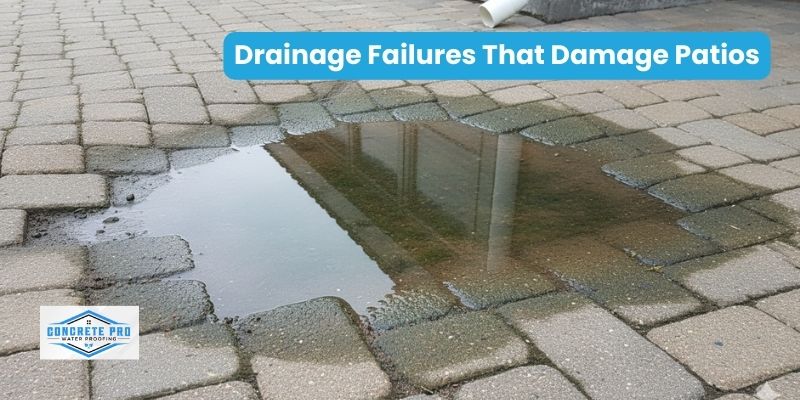
A patio that looks perfectly flat might seem ideal, but it is a problem waiting to happen. Without slope, water has nowhere to go. It pools on the surface, seeps into joints and saturates the base below. Over time that trapped moisture weakens the entire system.
What should happen instead:
- Patios should slope about ⅛ to ¼ inch per foot.
- Always slope away from the house or structure.
- Slope should be confirmed during base prep, not guessed at the end.
The slope does not need to be visible; it just needs to exist.
Drainage Mistake #2: Inadequate or Missed Base Preparation
This is the hidden culprit behind countless patio problems. Some people lay pavers or concrete right onto the soil or maybe throw down a thin layer that barely gets compacted. Water ends up pooling, with nowhere to drain. Before you know it, things start to settle or move, and your patio is no longer level.
Here is what a proper base really requires:
- Dig deep enough to allow for the right drainage layers.
- Add crushed stone or aggregate, compacting it in layers.
- Create a stable, permeable base that can support weight and allow water to flow through.
If your base cannot handle drainage, anything that you build on top will not last long.
Drainage Mistake #3: No Edge Restraints
Edge restraints do not just keep pavers neat; they keep them stable. Without them pavers slowly spread outward. Gaps open. Water finds new entry points. Erosion accelerates.
The fix:
- Install rigid edge restraints around the entire perimeter.
- Anchor them into the compacted base.
- Ensure that they stay buried and supported over time.
It is a small detail, with big structural consequences.
Drainage Mistake #4: Missing or Misplaced Drains
Some patios need more than just a proper slope, especially larger ones or those hit with heavy rain. If you leave out drains, water will collect in the lowest areas. Put drains in the wrong spots, and you’ve essentially created a water trap, instead of an escape route.
What actually helps:
- Install channel or trench drains at the lowest points.
- Place slot drains by doors, steps and any entryways.
- Make sure that all drains connect, so water flows safely to a runoff area or dry well.
Let gravity do its job. Do not complicate things.
Drainage Mistake #5: Using the Wrong Joint Material
What goes between your pavers matters a lot. Regular sand? It just washes away when it rains. As the sand erodes, gaps widen, more water slips through, and the pavers can start to move.
A better option: Use polymeric sand that hardens when moistened. This holds the joints together, while still allowing controlled drainage. You reduce erosion, without trapping water underneath.
It is about balance—keeping things secure, without turning your patio into a puddle.
Drainage Mistake #6: Ignoring Surrounding Water Sources
A patio does not exist in isolation. Water from your roof, downspouts, sloped yards or landscaping can all find its way to your patio, even if it’s built perfectly.
Plan:
- Direct downspouts away from the patio.
- Regrade soil, so water moves away from the area.
- Add swales or subsurface drains, if needed.
- Use gravel or permeable borders, to slow water down.
Most drainage problems actually begin outside the patio itself.
Drainage Mistake #7: Skipping Maintenance
Even top quality patios need some care over time. Joints can wear out, pavers may settle, and drains can clog. If you skip maintenance, drainage suffers, and old issues return.
Keep up with it:
- Replace joint sand, when it starts to get low.
- Relevel any areas that begin to sink.
- Clean out drains and channels, before they back up.
- Watch for early signs of puddles or shifting.
A little maintenance makes a big difference, in your patio and your peace of mind.
How Poor Drainage Damages Your Patio
Water has the following structural effects on patios:
- Sub-base saturation decreases the heavy load bearing.
- Erosion corrodes the support.
- Freeze expansion results in pressure upwards and outwards.
- Differential settlement results in unequal movement.
- Materials decay more quickly, when exposed to constant moisture.
As stated above, poor drainage not only accelerates a patio’s aging process; it can also “break” a patio.
When to Call a Professional
It is time for a professional evaluation, if you are seeing:
- Persistent puddles
- Sinking or tilting pavers
- Cracking concrete
- Repeated joint washout
- Water moving toward your home
Drainage issues are often hidden below the surface. Fixing symptoms without addressing the cause almost guarantees that the problem will return.
Conclusion
A patio should feel solid underfoot and stress free in the rain. If water is not managed properly, even the best materials will not save it. Drainage is not optional; it is foundational. If you are planning a new patio or dealing with drainage problems on an existing one, Concrete PRO can help. Our team understands how slope, base preparation and water flow work together, to protect pavers, concrete and stone for the long term.