Concrete is a highly versatile and sturdy material in the building industry; however, it does not last indefinitely. Driveways, sidewalks, patios, and garage floors crack and settle over time, losing their structural integrity. Broken concrete is about more than simply seeing what is wrong; it is about knowing what to do next. This decision may impact your budget, your safety, and your future property value.
Choosing whether to fix concrete or replace it is not about guesswork; it is a careful consideration of the damage, how the surface is used, and the slab's future. Below you will find a step-by-step outline of a workable framework that concrete professionals use when gauging whether to repair your slab or pour a new one.
Understanding the Differences: Repair vs. Replacement
It is helpful to have a brief overview of the two fundamental approaches before getting into the details.
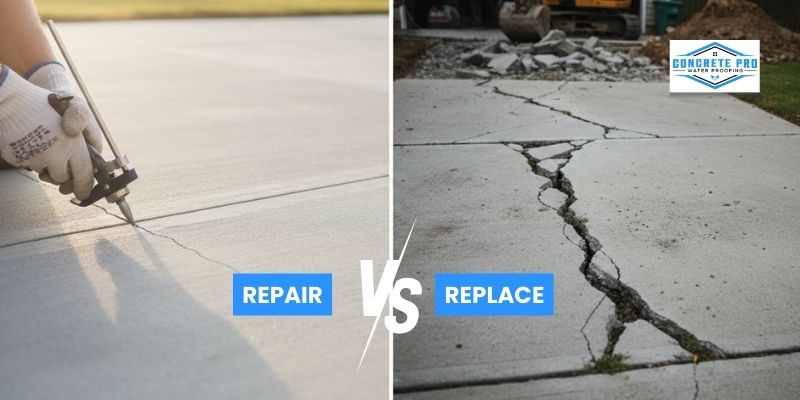
Concrete repair specializes in correcting specific issues: sealing cracks, flattening sinking areas, restoring worn areas, or repairing surface damage. The cost of repairs tends to be cheaper early on, before conditions become severe.
Concrete replacement involves removing the existing slab and pouring new concrete. It can be seen as both a long-term and long-lasting investment in performance, and in most cases, it fixes the root cause of a problem that simple repairs cannot solve.
The choice is not entirely clear, and several indicators can tip the balance either way.
When Repair Is the Right Choice
When damage is more cosmetic than structural, and the slab beneath it remains fundamentally stable, repair is a smart option. The following are situations in which repair is reasonable:
1. Minor Cracks and Surface Damage
Hairline or surface cracks less than approximately ¼ inch in width are typically amenable to crack filling and sealing. This type of repair ensures that water cannot infiltrate, weeds cannot grow, and further deterioration of the concrete is prevented.
2. Budget Constraints and Short-Term Needs
When you have a tight budget or plan to upgrade other items in the future, repairs can help extend the lifespan of your concrete at a small fraction of replacement costs. This path is used by many homeowners, allowing them extra time until a complete replacement is feasible.
3. Quick Fixes and Minimal Disruption
Repair work is less time-consuming and less of a hassle than replacement. Your driveway must be used again this week, or your patio needs a secure surface for a weekend gathering. Repairs can provide that in a fraction of the time required for a complete tear-out.
4. Localized Damage
When only a small area of the slab has been compromised—a corner of the driveway, a cracked sidewalk panel, or an old spot by the garage—it is possible to do a local repair rather than replace the entire slab.
When Replacement Is the Better Investment
Repair can be an excellent short-term, low-cost solution… but not necessarily the right long-term solution. Replacement can be the wiser option in a variety of obvious circumstances:
1. Widespread or Deep Structural Damage
Cracks running through the slab, a series of intersecting cracks, or significant heaving and settling are typical signs that the substructure has been weakened. Patching will not remedy the underlying soil movement or foundation failure; replacement is the only way to address those problems.
2. Multiple Failed Repairs
Filling the same cracks every year is proof that the surface cannot be fixed with easy solutions. A few temporary fixes would be costly in the long run (lower longevity but higher cost).
3. Severe Unevenness and Settling
When concrete portions fall, slope too steeply, or have a height difference of more than a couple of inches, the underlying soil or drainage system usually becomes ineffective. Replacing the slab will allow you to address the problem by correcting the grading and compaction.
4. Concrete at the End of Its Service Life
Concrete can last for decades, but no material is eternal. If a decades-old driveway, pad, or walkway is chronically deteriorating, replacing it usually yields a maintenance-free and durable surface that will last 20 to 30 years.
5. Changing Usage or Load Requirements
You might be looking to add some heavy equipment or install a carport or patio, which you are converting into a new workspace. When the existing concrete is not sufficiently strong to support the latest load or traffic, it may be more prudent to start fresh with a reinforced, heavier slab.
Evaluating Your Situation: A Practical Decision Guide
The following is a checklist that you can use to assess your needs:
Consider Repair. When:
- Cracks are minor and superficial.
- The failure is focused on a small, localized area.
- You need a fast, inexpensive solution.
- The slab has been more recently renovated and is still largely structurally sound.
Consider Replacement. When:
- Cracks are broad, deep, or structural.
- Several repairs have already failed.
- The slab is extremely unequal or sinking.
- The concrete is either old or heavily in use.
- Your plans require a firmer surface.
Conclusion
Concrete problems are not always massive in nature; you need a clear means of figuring out what will work best for your property. Less severe cracks and surface defects? Repair might be all you need. Rampant structural issues or chronic settling? A replacement will save you time, money, and stress in the future.
Whatever your actual dilemma, professional advice can change everything. To determine the most appropriate choice for your home or business, contact Concrete PRO.